
AWS CCP Exam Prep: Understanding AWS Billing, Pricing and Support - Part 4
Welcome to part 4 of my AWS Certified Cloud Practitioner exam prep series. This post continues where Part 3 left off. In part 1, I covered AWS pricing models. In part 2, I covered storage options and tiers. In part 3, I covered billing, budget and cost management.
AWS Parts 1 and 2 fall under Task Statement 4.1: Compare AWS Pricing models . Part 3 falls under AWS Task Statement 4.2: Understand resources for billing, budget, and cost management . Part 4 begins AWS Task Statement 4.3: Identify AWS technical resources and AWS Support options , and will close out the Billing, Pricing, and Support series.
All examples here use us-east-2 unless otherwise noted.
This post focuses on AWS CCP Exam Task Statement 4.3: Identify AWS technical resources and AWS Support options.
My last practice test results after writing parts 1, 2 and 3, and before writing part 4:
- 70% required to pass.
- My Score: 81%
- 53 out of 65 questions correct.
- Result: Passed.
Please note that, while writing parts 1, 2, and 3 definitely contributed to the improvement in my score, I have been studying in other ways as well.
At this point, I have consistently scored over 70% on the last 3 attempts. My efforts writing this series are paying off. Writing the series has also significantly improved my score in the billing, pricing, and support category, which was my weakest area before writing this series. For this test, my score in the Billing and Pricing section was 86% correct and 14% incorrect.
I think I’m probably ready to go ahead and schedule the exam, and I likely don’t need to keep writing this series. However, I’m going to finish the billing, pricing, and support series anyway, as it may help others interested in taking the same exam. It also won’t hurt me in the long run.
The next Task Statement under the content domain is AWS Task Statement 4.3: Identify AWS technical resources and AWS Support options .
This task statement covers:
- Resources and documentation available on official AWS websites.
- AWS Support plans.
- Role of the AWS Partner Network, including independent software vendors and system integrators.
- AWS Support Center.
AWS offers the following resources for engineers working with AWS:
AWS Documentation
- Every AWS service has its own documentation resource.
- The AWS URL for each service page typically follows the aws.amazon.com/{servicename} pattern.
- The Amazon S3 page is one example.
- These pages are considered the primary, authoritative source of truth for AWS services.
AWS Whitepapers
- For readers completely new to the subject, Whitepapers are not unique to AWS. Wikipedia defines a Whitepaper as “…a report or guide that informs readers concisely about a complex issue and presents the issuing body’s philosophy on the matter.” (Wikipedia )
- Whitepapers are technical content authored by AWS and the AWS community.
- Whitepapers can be found on the AWS Whitepapers & Guides page.
AWS Knowledge Center & AWS re:Post
- I’m including the two of these in the same item. Before March 2023, AWS re:Post was a community-driven Q&A service, while AWS Knowledge Center published AWS-produced troubleshooting articles. After March 2023, however, these were merged into one service.
- AWS Knowledge Center is a technical resource with articles and videos covering the most frequently asked questions and requests received by AWS customers.
- At the time of writing this article, the first two featured articles in the AWS Resource Center are Why don’t my Amazon S3 objects replicate when I set up replication between my buckets? and Why can’t I connect to my Amazon EC2 instance? .
AWS offers several support plans. For the current AWS CCP exam: The plans fall into the following main categories: Basic, Developer, Business, and Enterprise. However, please note that this structure is based on an older AWS support model. Some of these plans are being discontinued on January 1, 2027, and are currently being replaced by different support plan offerings. If a plan is being discontinued by AWS, I have noted that under the section for that plan. The newer plans appear at the end of the list.
AWS Basic Support Plans
- This plan is free for all AWS customers.
- Only the Core Checks of AWS Trusted Advisor are included.
- The AWS Health Dashboards are included.
AWS Developer Support Plan
- This plan is a support plan for individuals or teams that need technical support while doing development on AWS.
- Only the Core Checks of AWS Trusted Advisor are included.
- The AWS Health Dashboards are included.
- The plan offers enhanced technical support.
- This plan is being discontinued on January 1, 2027.
AWS Business Support Plan
- This support plan is for business operating their infrastructure on AWS.
- It is the lowest tier support plan that offers 24/7 access to cloud experts.
- It is the lowest tier support plan that offers personalized recommendations.
- All AWS Trusted Advisor checks are included.
- The AWS Health Dashboards are included.
- This plan is being discontinued on January 1, 2027.
AWS Enterprise On-Ramp
- This is a temporary support plan for customers that need more support than the Business plan can provide, but aren’t ready for full Enterprise support.
- All AWS Trusted Advisor checks are included.
- The AWS Health Dashboards are included.
- This plan uses a pool of technical account managers instead of a dedicated account manager.
- This plan is being discontinued on January 1, 2027.
AWS Enterprise Support Plan
- Offers the highest level of AWS support.
- All AWS Trusted Advisor checks are included.
- The AWS Health Dashboards are included.
- Includes a dedicated technical account manager.
- Includes what AWS refers to as a “White-glove billing concierge” for assistance managing billing, account, and cost optimization.
- Includes 24/7 access to the AWS Security Incident Response team.
The following are the newest support plan offerings from AWS.
AWS Business Support+
- Provides 24/7 access to AWS experts.
- All AWS Trusted Advisor checks are included.
- The AWS Health Dashboards are included.
- Billed at whichever is greater: $29/month per account or a % of monthly AWS charges, tiered based on usage.
AWS Unified Operations
- Provides 24/7 access to AWS experts.
- All AWS Trusted Advisor checks are included.
- The AWS Health Dashboards are included.
- AWS specialists act as an extension of your team through collaboration channels.
- Includes 24/7 security and performance monitoring.
- The AWS Support Center is the main resource for things like:
- Creating support cases.
- Managing support plans.
- Access Trusted Advisor.
- Access the AWS Health Dashboard.
- The AWS Support Center is available to all accounts, but the features will depend on the support plan.
- AWS Trusted Advisor is a tool that automatically and continuously evaluates your AWS environment using best practice checks.
- The core checks are available to all AWS account plans.
- Additional checks are only available to the Business, Enterprise and higher-tier support plans.
- The AWS Service Health Dashboard is a global dashboard that reports the health of AWS services.
- The AWS Service Health Dashboard is a publicly accessible resource.
- The dashboard can be accessed for all AWS locales or specific locales, such as North America.
- The dashboard can be searched by AWS service or by region.
- AWS Personal Health Dashboard is an account-specific, personalized health dashboard.
- AWS Personal Health Dashboard provides information specific to AWS resources running with your account.
- A user must be logged in to access the Personal Health Dashboard.
Here is a screenshot of my Personal Health Dashboard from my personal AWS account:
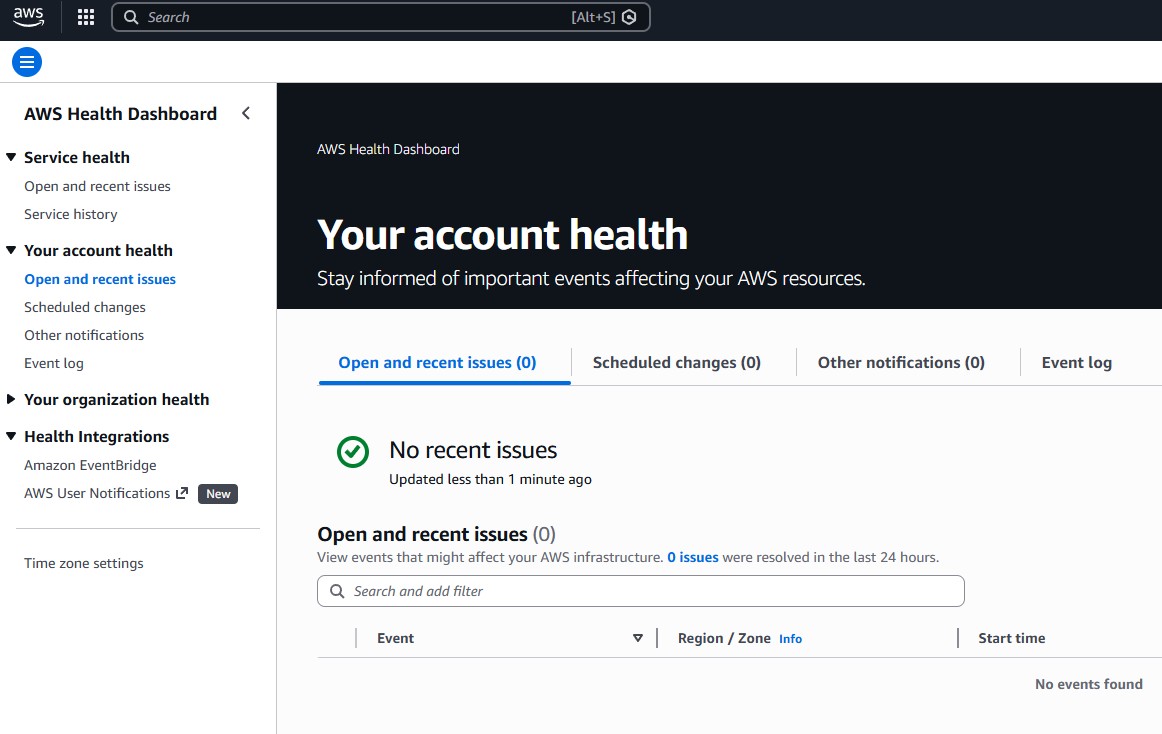
My AWS Personal Health Dashboard
I have no recent issues reported in my health dashboard. I would expect that to be the case. I use my personal account as an educational resource and I am not running any services. I currently don’t need or want to incur any costs associated with my personal AWS account. However, if I were running production services, the personal health dashboard would be an important resource.
- The AWS Partner Network (APN) is a global community of organizations that use the AWS cloud to build solutions and services for customers. It is essentially a network of knowledgeable consultants that can assist with personalized customers solutions and/or sell solutions on AWS Marketplace.
- AWS Marketplace is a service where third-party vendor services can be bought or sold.
- Vendors can make their Software as a Service (SaaS) offerings available to other AWS customers through AWS Marketplace.
- Customers can purchase third-party solutions through AWS Marketplace.
- This may be overly simplified, but I think of AWS Marketplace as an app store for AWS. Vendors can sell software on Marketplace/Customers can buy software on Marketplace.
That brings me to the end of my notes for part 4 and the final post in my AWS Billing, Pricing, and Support series. Writing this series has significantly improved my knowledge in this area. I plan to take the exam soon and now feel reasonably confident that I will pass. I also plan to write more AWS related posts in the future. These will either be more AWS certification prep resources or deep dives into specific AWS services or concepts. If you’re reading this as study prep for the AWS CCP exam, I hope you found the information helpful and best of luck on the exam!